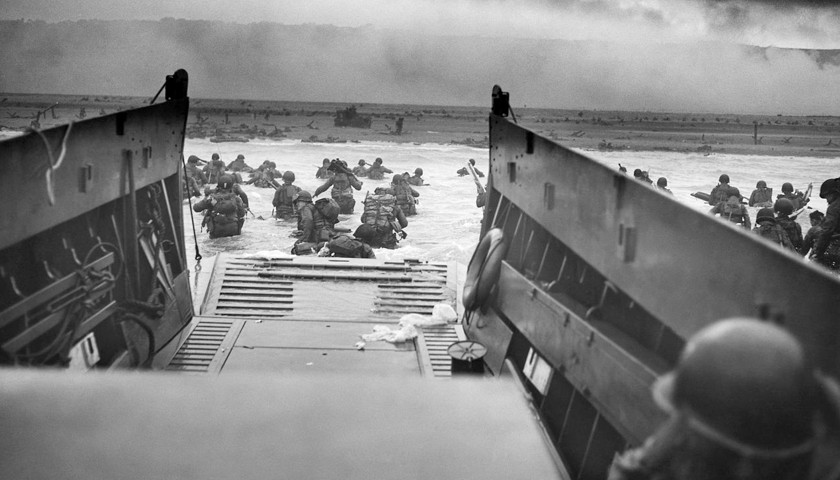
Eighty-two years ago on June 6, 1944, the United States, Great Britain, the Free French forces, Canada, and other Allies launched one of the most audacious military operations in history: the seaborne invasion of Normandy, France. Code-named Operation Overlord, the assault thrust 160,000 troops onto five beaches in a last-ditch bid to open a Western Front and crush Hitler’s Nazi empire.
For more than two and a half years, the Allies had meticulously planned the assault while Adolf Hitler fortified the French coastline with the formidable “Atlantic Wall.” There would be no second chance; the fate of Europe hinged on this decisive operation.
Elaborate Deception and Costly Rehearsals
The Allies knew that in order to have any chance at success, they had to convince Hitler that the main blow would be at Pas de Calais, not Normandy. And so the Allies set about creating an elaborate ruse they called Operation Fortitude — part of the larger Bodyguard plan. A fictitious “First U.S. Army Group” was created under General George S. Patton, complete with inflatable tanks, dummy landing craft, and false radio traffic. The deception worked: German forces, including elite Panzer divisions, remained pinned away from Normandy for critical days after the landings.
Preparations for the operation were not without tragedy. In April 1944 — just two months before the Allies’ gambit — a full-scale rehearsal codenamed Exercise Tiger off the coast of England turned deadly when German E-boats attacked, killing more than 700 American servicemen. The tragedy was kept secret at the time to preserve morale and security.

The Fateful Decision
After stormy weather forced a postponement, Supreme Allied Commander General Dwight D. Eisenhower made the fateful call on the evening of June 4. Operation Overlord would proceed on Tuesday, June 6.
Eisenhower’s own words captured the gravity. “This operation is not being planned with any alternatives. This operation is planned as a victory, and that’s the way it’s going to be.” He later drafted a private note accepting full blame if the invasion failed. “Our landings… have failed and I have withdrawn the troops.,” he wrote. The general later tossed it away after success.
Group Captain James Stagg, Eisenhower’s chief meteorologist, delivered the critical forecast that gave Eisenhower the narrow window he needed.
British Prime Minister Winston Churchill called the operation “undoubtedly the most complicated and difficult that has ever occurred.”
Intelligence Edge
Much of the success of D-Day was made possible by the Allies’ top-secret codebreaking efforts at Bletchley Park. Years earlier, British mathematician Alan Turing and his team had developed techniques and machines (the “Bombe”) that cracked the German Enigma cipher. By 1941–43, Allied intelligence was routinely reading German naval and army communications. This advantage helped protect the massive buildup of troops and supplies in Britain and kept the Germans guessing about Allied intentions.
Politics on the Home Front
In the United States, President Franklin D. Roosevelt was navigating both the war and an unprecedented fourth-term presidential campaign. Just days before D-Day, Allied forces had liberated Rome. The success of Normandy would bolster Roosevelt’s leadership narrative as he faced Republican challenger Thomas E. Dewey in the November election. FDR addressed the nation that evening with a D-Day Prayer, asking Americans to join him in prayer for “our sons, pride of our Nation,” who had launched the “mighty endeavor.”
In Great Britain, Churchill led a wartime national coalition government that included Conservatives, Labour, and Liberals — a rare display of political unity forged in crisis after he replaced Neville Chamberlain in May 1940. Labour’s Clement Attlee served as Deputy Prime Minister. While the coalition held firm through the darkest days of the war, underlying tensions over postwar reconstruction would surface dramatically in the July 1945 general election, when voters turned to Labour and Attlee despite Churchill’s wartime leadership.
At the time, no one knew the invasion would succeed. Facing fortified defenses, heavy casualties, and battle-hardened German troops, the Allies nevertheless secured the beachheads. The Normandy campaign became the beginning of the end for Nazi Germany. After nearly a year of grueling fighting across Europe, Germany surrendered unconditionally on May 8, 1945.
– – –
Christina Botteri is the Executive Editor of The Tennessee Star and The Star News Network. Follow her on X at @christinakb.